A Trip to Corinth: Such Were Some of You
Salvation · The power of the gospel
Corinth was so famous for sexual sin that the Greeks turned its name into a verb for it. Yet in that very city the gospel of a crucified Jew raised up a church, and Paul could write to its members, “such were some of you: but ye are washed.”
“For I am not ashamed of the gospel of Christ: for it is the power of God unto salvation to every one that believeth; to the Jew first, and also to the Greek.” (Romans 1:16)
A City Between Two Seas
Come with me on a trip to Corinth. The city sat on a narrow neck of land, about six kilometres wide, joining mainland Greece to the Peloponnese. It had two harbours: Lechaeum, facing west toward Italy, and Cenchreae, facing east toward Asia. Rather than sail around the stormy southern tip of Greece, many captains carried their cargo across the isthmus, and smaller ships were dragged over on a stone track called the diolkos.
This made Corinth rich, crowded and restless. Sailors, merchants and travellers came and went every day, many far from home with money in their pockets and no one watching them. Every port city knows what follows such crowds, and Corinth knew it better than most.
The First Corinth: Aphrodite on the Hill
Above the city rose the Acrocorinth, a rocky mountain nearly 575 metres high. On its summit stood a temple of Aphrodite, the Greek goddess of love, sex and beauty. The Romans later called her Venus.
The Greek geographer Strabo, writing around the time of Christ, looked back on the older city and reported that this temple had once owned more than a thousand temple slaves, prostitutes given to the goddess as offerings, whose earnings went to the temple. He quoted an old saying: “Not for every man is the voyage to Corinth.”1 A trip to Corinth could cost a man everything he had.
The city’s name became a byword. The comic playwright Aristophanes, about four centuries before Paul, used the verb korinthiazomai, “to Corinthianize,” to mean to commit fornication. The philosopher Plato used “a Corinthian girl” to mean a prostitute. Other Greek writers produced plays titled The Corinthian Whoremonger. To the Greek world, “Corinthian” meant sexual immorality.2
This first Corinth came to a violent end. In 146 BC it joined a revolt against Rome. The Roman general Lucius Mummius captured it, killed many of its men, sold the women and children into slavery, and left the city in ruins. For about a hundred years Corinth lay almost empty.3
The Second Corinth: New Stones, Old Sins
In 44 BC Julius Caesar refounded Corinth as a Roman colony, settled largely with freed slaves. Merchants and fortune-seekers soon poured in from across the empire. By Paul’s day it was the capital of the Roman province of Achaia, and every two years it hosted the Isthmian Games.
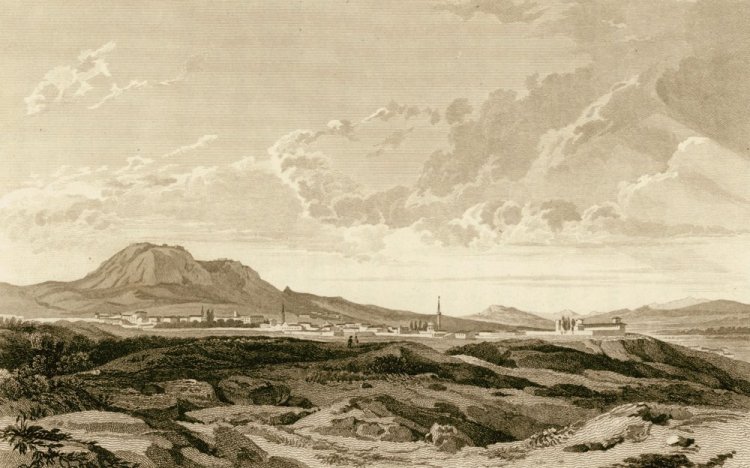
Edward Dodwell, Corinth (1819). Public domain.
This was the Corinth Paul entered around AD 50. The stones were new, but the sins were old. Historians debate whether temple prostitution still went on in Paul’s day; Strabo himself spoke of it as a thing of the past. Yet a small temple of Aphrodite still stood on the Acrocorinth, idols filled the city, and in a busy port of sailors and travellers prostitution thrived as it always had.4
Ellen White describes the city Paul met in these words:
“The city was almost wholly given up to idolatry. Venus was the favorite goddess, and with the worship of Venus were connected many demoralizing rites and ceremonies. The Corinthians had become conspicuous, even among the heathen, for their gross immorality. They seemed to have little thought or care beyond the pleasures and gaieties of the hour.”5
The clearest proof that the old sins lived on comes from Paul himself. His letters to the believers deal with a man living with his father’s wife (1 Corinthians 5:1), with church members joining themselves to prostitutes (1 Corinthians 6:15, 16), and with feasting at idol temples where immorality followed (1 Corinthians 8:10; 10:7, 8). The city had been destroyed and rebuilt, but the human heart had not changed. Only one thing could change it.
From Athens to Corinth
Paul came to Corinth straight from Athens (Acts 18:1). In Athens, the proud centre of Greek learning, he had reasoned with philosophers on Mars’ Hill. He quoted their own poets and spoke of the unknown God. Some mocked, others said they would hear him again, and only a few believed, among them Dionysius and a woman named Damaris (Acts 17:32–34).
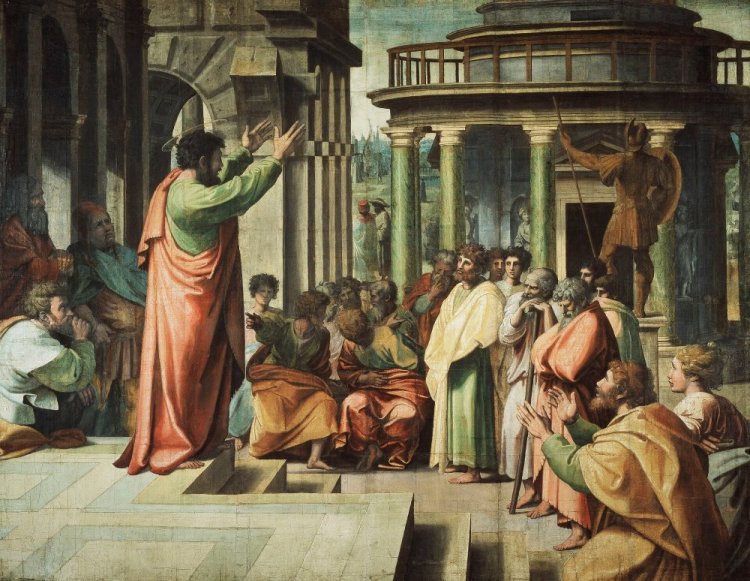
Raphael, St Paul Preaching in Athens (c. 1515). Public domain.
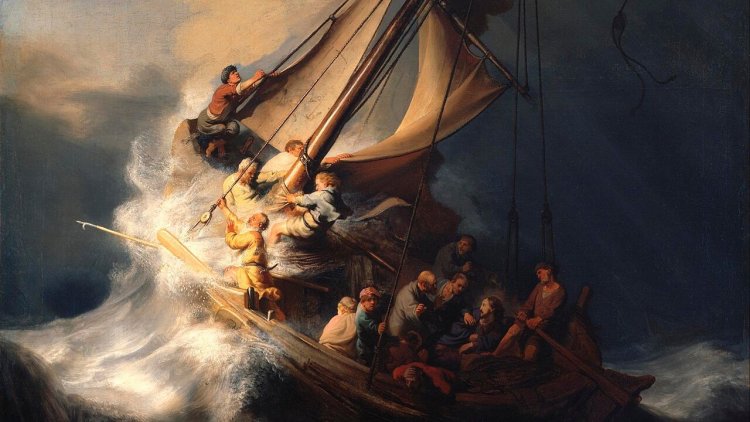
Paul did not leave Athens a beaten man, but he left with a lesson. Ellen White explains:
“In preaching the gospel in Corinth, the apostle followed a course different from that which had marked his labors at Athens. While in the latter place, he had sought to adapt his style to the character of his audience; he had met logic with logic, science with science, philosophy with philosophy. As he thought of the time thus spent, and realized that his teaching in Athens had been productive of but little fruit, he decided to follow another plan of labor in Corinth in his efforts to arrest the attention of the careless and the indifferent.”6
She returns to the same lesson in The Ministry of Healing:
“The experience of the apostle Paul in meeting the philosophers of Athens has a lesson for us. In presenting the gospel before the court of the Areopagus, Paul met logic with logic, science with science, philosophy with philosophy. The wisest of his hearers were astonished and silenced. His words could not be controverted. But the effort bore little fruit. Few were led to accept the gospel. Henceforth Paul adopted a different manner of labor. He avoided elaborate arguments and discussion of theories, and in simplicity pointed men and women to Christ as the Saviour of sinners.”7
Right after this she quotes Paul’s own words from 1 Corinthians 2 and then Romans 1:16, the key text of this article. The gospel itself, not clever argument, is the power of God unto salvation.
Christ and Him Crucified
Paul tells us his new plan in his own words:
“And I, brethren, when I came to you, came not with excellency of speech or of wisdom, declaring unto you the testimony of God. For I determined not to know any thing among you, save Jesus Christ, and him crucified. And I was with you in weakness, and in fear, and in much trembling. And my speech and my preaching was not with enticing words of man’s wisdom, but in demonstration of the Spirit and of power: that your faith should not stand in the wisdom of men, but in the power of God.” (1 Corinthians 2:1–5)
This was a bold choice. To Greeks the cross was a shameful death for slaves and criminals. Paul admitted that Christ crucified was “unto the Jews a stumblingblock, and unto the Greeks foolishness” (1 Corinthians 1:23). Yet he would preach nothing else, because “the preaching of the cross is to them that perish foolishness; but unto us which are saved it is the power of God” (1 Corinthians 1:18).
The word “saved” in that verse is the Greek sōzō, the word that gives Sozo its name. It means to save, to heal and to make whole. Paul knew that no argument could heal a Corinthian heart. Only the sight of God’s love at the cross could do that. Ellen White writes that Paul “knew by personal experience that when a sinner once beholds the love of the Father, as seen in the sacrifice of His Son, and yields to the divine influence, a change of heart takes place, and henceforth Christ is all and in all.”8
How Paul Laboured in Corinth
Paul did not preach at the city from a distance. He moved in, lodging with Aquila and Priscilla, “for by their occupation they were tentmakers” (Acts 18:3), and working with his hands among the very people he hoped to reach. He reasoned in the synagogue every Sabbath, and when opposed, he moved next door to the house of Justus. Then the harvest began: “Crispus, the chief ruler of the synagogue, believed on the Lord with all his house; and many of the Corinthians hearing believed, and were baptized” (Acts 18:8).
Still, Corinth weighed on him. Ellen White says the wickedness he saw there “almost disheartened him,” and that “he doubted the wisdom of trying to build up a church from the material that he found there.”9 Then the Lord spoke to him in a vision:
“Be not afraid, but speak, and hold not thy peace: for I am with thee, and no man shall set on thee to hurt thee: for I have much people in this city.” (Acts 18:9, 10)
God had “much people” in Corinth, people He could see even when Paul could not. So Paul stayed “a year and six months, teaching the word of God among them” (Acts 18:11).
His ministry reached the whole person. Ellen White describes it:
“The apostle’s efforts were not confined to public speaking; there were many who could not have been reached in that way. He spent much time in house-to-house labor, thus availing himself of the familiar intercourse of the home circle. He visited the sick and the sorrowing, comforted the afflicted, and lifted up the oppressed. And in all that he said and did he magnified the name of Jesus.”10
This is Christ’s own method. “Christ’s method alone will give true success in reaching the people. The Saviour mingled with men as one who desired their good. He showed His sympathy for them, ministered to their needs, and won their confidence. Then He bade them, ‘Follow Me.’”11 Paul mingled as a fellow worker, showed sympathy, visited the sick, and lifted the oppressed, and then he pointed them to Christ.
God also confirmed the message with power. Paul later reminded the Corinthians: “Truly the signs of an apostle were wrought among you in all patience, in signs, and wonders, and mighty deeds” (2 Corinthians 12:12). His preaching came “in demonstration of the Spirit and of power” (1 Corinthians 2:4). Body and soul were both in view. This is sōzō: the gospel that saves, heals and makes whole.
The result? “Many turned from the worship of idols to serve the living God, and a large church was enrolled under the banner of Christ. Some were rescued from among the most dissipated of the Gentiles and became monuments of the mercy of God and the efficacy of the blood of Christ to cleanse from sin.”12
A Church Still Fighting Corinth
It would be a nice story if the converts simply left their old lives behind for good. Paul’s letters tell a more honest story. Ellen White writes that “the members of the church at Corinth were surrounded by idolatry and sensuality of the most alluring form.”13 While Paul was with them, these influences had little power. After he left, many grew careless, “and not a few who, at the time of their conversion, had put away their evil habits, returned to the debasing sins of heathenism.”14
The reports that reached Paul in Ephesus were painful. A man was living with his father’s wife (1 Corinthians 5:1). Some members still went to the city’s prostitutes, and Paul pleaded: “shall I then take the members of Christ, and make them the members of an harlot? God forbid” (1 Corinthians 6:15). Even in his second letter he feared he would “bewail many which have sinned already, and have not repented of the uncleanness and fornication and lasciviousness which they have committed” (2 Corinthians 12:21).
This is a church we can recognize. They were baptized believers who still felt the pull of the city around them. The gospel had reached them, but Corinth was still trying to reach back in. Paul did not excuse their sin, and he did not give up on them either. He pointed them again to what Christ had already done for them.
Such Were Some of You
In the middle of his warnings Paul writes one of the most hopeful lines in the Bible:
“Know ye not that the unrighteous shall not inherit the kingdom of God? Be not deceived: neither fornicators, nor idolaters, nor adulterers, nor effeminate, nor abusers of themselves with mankind, nor thieves, nor covetous, nor drunkards, nor revilers, nor extortioners, shall inherit the kingdom of God. And such were some of you: but ye are washed, but ye are sanctified, but ye are justified in the name of the Lord Jesus, and by the Spirit of our God.” (1 Corinthians 6:9–11)
Read that list slowly. It reads like a walk through the streets of Corinth: the brothel, the temple, the tavern, the market where people cheated each other. Then come four words: “such were some of you.” The people sitting in that church had once been those people. Some had paid for prostitutes. Some had worshipped Aphrodite. Some had been drunkards and thieves.
But Paul does not stop there. He says three things God did for them:
- Ye are washed. The filth of the past was cleansed by the blood of Christ.
- Ye are sanctified. They were set apart for God, made holy and given a new purpose.
- Ye are justified. God made them righteous “in the name of the Lord Jesus, and by the Spirit of our God.” He did not only cancel their guilt; He gave them a new heart.
This is the power of the gospel that Paul was not ashamed of (Romans 1:16). It is power “to every one that believeth,” the Greek of Corinth as well as the Jew. No city was too dark and no sinner too far gone. “Therefore if any man be in Christ, he is a new creature: old things are passed away; behold, all things are become new” (2 Corinthians 5:17).
Notice too that Paul writes “were,” not “are.” The gospel does not leave a person as it found him. Justification is not a legal fiction that leaves the sinner as he was. The God who pardons also transforms; He makes the sinner righteous. Ellen White writes that in Christ crucified the Corinthians “were offered power sufficient to convert the soul and divinely adapted to enable them to resist all temptations to evil.”15
Ellen White makes the same point about God’s forgiveness:
“God’s forgiveness is not merely a judicial act by which He sets us free from condemnation. It is not only forgiveness for sin, but reclaiming from sin. It is the outflow of redeeming love that transforms the heart.”16
The Corinthians were not simply told they were clean while they stayed in the brothel. They were washed, set apart and made righteous, so that they no longer lived as they once had.
Corinth in Your Pocket
In Paul’s day a man had to travel to Corinth, climb the hill or walk the harbour streets, and pay with his own coins. Today Corinth travels to him. It sits in the phone in his pocket, open at any hour, in private, and often free. Pornography is the temple of Aphrodite brought into the bedroom.
The numbers are sobering. Most careful studies come from the United States, but the same screens are now in every nation:
- In 2019 a single pornography website reported 42 billion visits, about 115 million visits every day.17
- A 2022 national survey of American teenagers by Common Sense Media found that 73% of those aged 13 to 17 had seen pornography online. The average age of first exposure was 12, and 15% had seen it at age 10 or younger. Half of those who had seen it said they felt guilty or ashamed afterward.18
- In a nationally representative U.S. study published in 2019, about 11% of men and 3% of women agreed with the statement “I am addicted to pornography.”19
- Barna Group’s 2024 report Beyond the Porn Phenomenon found that 61% of American adults view pornography. Among practising Christians the figure was 54%. Nearly one in five pastors said they currently struggle with it, and half of all users said no one knows about their use.20
The problem is not only American. A 2014 study of 487 male students at public and private universities in Kenya found that 93% had been exposed to some form of sexually explicit material, and 16.7% were highly exposed.21
The World Health Organization now lists compulsive sexual behaviour disorder in its International Classification of Diseases (ICD-11).22 Whatever label is used, many people know from experience what the Bible already said: “whosoever committeth sin is the servant of sin” (John 8:34). What starts as curiosity becomes a habit, and the habit becomes a chain.
The damage is real. Pornography trains the eyes to see people as objects. It feeds the imagination with what Jesus called adultery of the heart: “whosoever looketh on a woman to lust after her hath committed adultery with her already in his heart” (Matthew 5:28). It breaks trust in marriages, shapes the expectations of children before they understand what they are seeing, and fills sincere believers with shame that keeps them silent and alone.
Ellen White described this process long before the internet existed. Writing of how Israel was led into sin, she warned: “By beholding we become changed. By the indulgence of impure thoughts man can so educate his mind that sin which he once loathed will become pleasant to him.”23 What first shocks the conscience slowly becomes normal, and then desired. She also wrote: “Polluted thoughts harbored become habit, and the soul is scarred and defiled.”24 This is the damage of pornography. It does not stay on the screen. It shapes the mind, and the mind shapes the life.
Shame and silence are where the enemy wants them. The Corinthians at least had Paul to write to them plainly. Many today struggle with no one beside them at all. If you are one of them, the next sections are for you.
A Scarlet Cord in Jericho
Long before Corinth, there was a woman in Jericho who lived by the same trade that filled Corinth’s streets. The Bible does not hide it. When Joshua’s two spies entered the city, they “came into an harlot’s house, named Rahab, and lodged there” (Joshua 2:1). Her house was built into the city wall, “and she dwelt upon the wall” (Joshua 2:15), a place where strangers came and went.
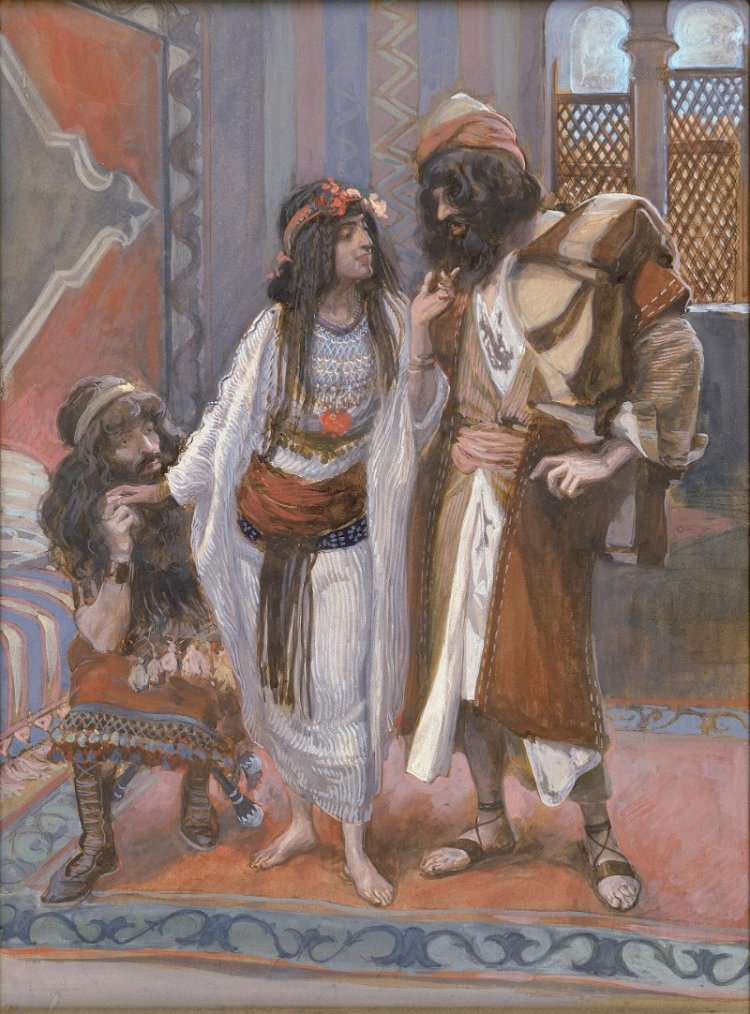
James Tissot, The Harlot of Jericho and the Two Spies (c. 1896–1902). Public domain.
Rahab had heard what God had done for Israel, and her heart was moved. She confessed: “the LORD your God, he is God in heaven above, and in earth beneath” (Joshua 2:11). She hid the spies, and they gave her a sign of safety, a line of scarlet thread in her window (Joshua 2:18). When the walls of Jericho fell, “Joshua saved Rahab the harlot alive, and her father’s household, and all that she had” (Joshua 6:25).
That was not the end of her story. Rahab married into Israel and became the mother of Boaz, the great-great-grandmother of King David, and an ancestor of Jesus Himself: “Salmon begat Booz of Rachab” (Matthew 1:5). The book of Hebrews names her among the heroes of faith: “By faith the harlot Rahab perished not with them that believed not, when she had received the spies with peace” (Hebrews 11:31).
Notice something striking. Even after she was saved, the Bible keeps calling her “Rahab the harlot.” Hebrews 11:31 does, and so does James: “Likewise also was not Rahab the harlot justified by works, when she had received the messengers, and had sent them out another way?” (James 2:25). Centuries after Jericho fell, the old label still stood beside her name.
But the label did not define her. It was there to show how far grace had reached. The woman once known for her trade is remembered as a woman of faith, a mother in Israel, and an ancestor of the Messiah. What she had been became the background against which God displayed what He had made her.
This is the message of “such were some of you.” People may remember your past. The enemy will remind you of it. But your past is not your name before God. The same grace that rescued a harlot in Jericho washed the believers in Corinth, and it can wash you too.
Your Body, God’s Temple
High above Corinth stood a temple where bodies were sold. Paul answered it with a different temple:
“Flee fornication. Every sin that a man doeth is without the body; but he that committeth fornication sinneth against his own body. What? know ye not that your body is the temple of the Holy Ghost which is in you, which ye have of God, and ye are not your own? For ye are bought with a price: therefore glorify God in your body, and in your spirit, which are God’s.” (1 Corinthians 6:18–20)
Some in Corinth seem to have argued that what they did with the body did not matter to God (1 Corinthians 6:12, 13). Paul says the opposite: the body matters to God. He made it, Christ bought it, and the Holy Spirit lives in it. Ellen White notes that Paul “urged upon them the claims of Him to whom they had dedicated their lives at the time of their conversion” and “begged them to control the lower passions and appetites.”25
This is whole-person salvation, sōzō. Christ does not only forgive the soul; He reclaims the body, renews the mind and restores the will. Here are some practical ways to walk in that freedom:
- Come to Christ as you are. Do not wait to clean yourself up first. “Do not listen to the enemy’s suggestion to stay away from Christ until you have made yourself better; until you are good enough to come to God. If you wait until then, you will never come.”26
- Confess and receive cleansing. “If we confess our sins, he is faithful and just to forgive us our sins, and to cleanse us from all unrighteousness” (1 John 1:9).
- Make a covenant with your eyes. Job said, “I made a covenant with mine eyes; why then should I think upon a maid?” (Job 31:1). Decide ahead of time what you will not look at. Use filters, keep devices out of the bedroom, and put the phone down when you are tired or alone.
- Flee, do not argue. Paul’s command is “Flee fornication” (1 Corinthians 6:18). Joseph ran from Potiphar’s wife (Genesis 39:12). Leave the room, close the app, and go for a walk.
- Do not walk alone. Half of those who view pornography say no one knows.27 Tell a trusted, mature believer and ask them to pray with you and check on you.
- Pray in the moment of temptation. Jesus said, “Watch and pray, that ye enter not into temptation: the spirit indeed is willing, but the flesh is weak” (Matthew 26:41). When the urge comes, do not wait. Call on Jesus by name right then.
- Fill the mind with better things. Bring “into captivity every thought to the obedience of Christ” (2 Corinthians 10:5). Feed on Scripture, prayer, uplifting music and service to others.
If you fall, do not lie in the mud. Get up, confess, and go on. God’s promise stands: “There hath no temptation taken you but such as is common to man: but God is faithful, who will not suffer you to be tempted above that ye are able; but will with the temptation also make a way to escape, that ye may be able to bear it” (1 Corinthians 10:13).
No one has fallen too far for Christ to reach. “None are so low, so corrupt and vile, that they cannot find in Jesus, who died for them, strength, purity, and righteousness, if they will put away their sins, cease their course of iniquity, and turn with full purpose of heart to the living God.”28
The End of the Trip
Our trip to Corinth ends where it began, with a city that gave its name to sexual sin. The first Corinth was destroyed. The second Corinth was built on its ruins and repeated its sins. But in the middle of that second Corinth, God built a third thing: a church of washed, sanctified and justified people.
Corinth is not as far away as it seems. In Kenya, on the Nakuru–Eldoret highway, lies Salgaa. It began as a small market centre and grew because long-distance truck drivers, carrying goods from Mombasa to Uganda and beyond, made it their night stop. Where the trucks parked, the sex trade followed. Salgaa has long been known as the “Wild West” and a haven for prostitution, with hundreds of women waiting for the drivers who pass through.29 Like Corinth, it is a town on a trade route, full of travellers far from home with money in their pockets.
If the gospel could raise a church in Corinth, it can raise one in Salgaa. And it can do the same in your city, in your home and in your heart.
A prayer: Lord Jesus, You see the Corinth around me and the Corinth within me. I confess my sin and I come as I am. Wash me, sanctify me, and justify me by Your blood. Take my eyes, my mind and my body as Your temple, and give me power to flee every temptation. Let my life say, “such were some of us,” to the praise of Your grace. Amen.
The gospel that reached Corinth can reach you. What you were is not what you must remain.
“For I am not ashamed of the gospel of Christ: for it is the power of God unto salvation to every one that believeth; to the Jew first, and also to the Greek.” (Romans 1:16)

About the author
Belden Orina holds a BSc and an MSc in Computer Science from Periyar University, India, and is completing a Bachelor of Theology at Bugema University. He has a keen interest in health evangelism, lifestyle coaching and evangelistic ministry, and writes on the gospel that saves the soul and heals the body.
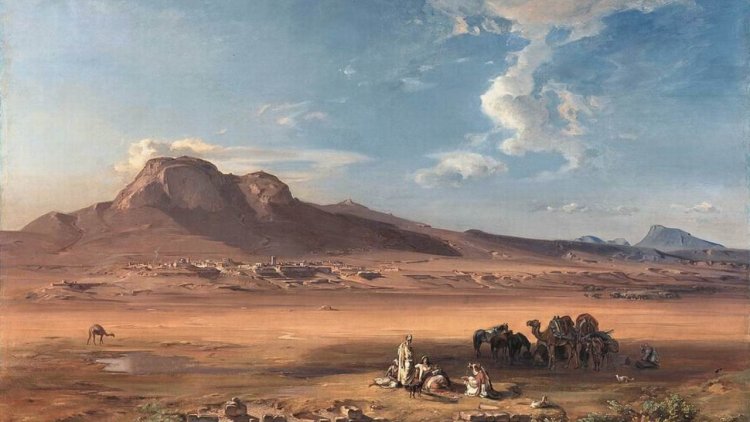
Cover: Carl Rottmann, Corinth with Akrocorinth (1847). Public domain.
Notes
Scripture quotations are from the King James Version.
- Strabo, Geography 8.6.20.
- Aristophanes, Fragment 354, cited in Liddell, Scott and Jones, A Greek-English Lexicon, s.v. korinthiazomai; Plato, Republic 404d; Athenaeus, Deipnosophists 313c, 559a.
- Strabo, Geography 8.6.23.
- Strabo, Geography 8.6.21; Barbette Stanley Spaeth, “Paul, Prostitutes, and the Cult of Aphrodite in Corinth,” Biblical Archaeology Review 49, no. 1 (Spring 2023).
- Ellen G. White, The Acts of the Apostles (Mountain View, CA: Pacific Press, 1911), 243, 244 (AA 243, 244).
- Ibid., 244 (AA 244).
- Ellen G. White, The Ministry of Healing (Mountain View, CA: Pacific Press, 1905), 214 (MH 214).
- White, The Acts of the Apostles, 245 (AA 245).
- Ibid., 250 (AA 250).
- Ibid.
- White, The Ministry of Healing, 143 (MH 143).
- White, The Acts of the Apostles, 252 (AA 252).
- Ibid., 299 (AA 299).
- Ibid., 299, 300 (AA 299, 300).
- Ibid., 307 (AA 307).
- Ellen G. White, Thoughts From the Mount of Blessing (1896), 114 (MB 114).
- Pornhub Insights, 2019 Year in Review, as reported by Newshub, December 2019.
- Common Sense Media, Teens and Pornography (2023; survey conducted September 2022). Press release
- Joshua B. Grubbs, Shane W. Kraus and Samuel L. Perry, “Self-Reported Addiction to Pornography in a Nationally Representative Sample,” Journal of Behavioral Addictions 8, no. 1 (2019): 88–93. Article
- Barna Group and Pure Desire Ministries, Beyond the Porn Phenomenon (Barna Group, 2024). Media fact sheet
- Ann Wamathai, Merecia A. M. Sirera and Margaret Mwenje, “Prevalence and Factors Contributing to Pornography Viewing among Male Students in Selected Universities in Kenya” (November 2014). Repository
- World Health Organization, International Classification of Diseases, 11th Revision (ICD-11), 6C72, compulsive sexual behaviour disorder.
- Ellen G. White, Mind, Character, and Personality, vol. 1 (Nashville: Southern Publishing Association, 1977), 75 (1MCP 75); originally in Patriarchs and Prophets, 459 (PP 459).
- Ibid., 235 (1MCP 235).
- White, The Acts of the Apostles, 306, 307 (AA 306, 307).
- Ellen G. White, Christ’s Object Lessons (1900), 205 (COL 205).
- Barna Group and Pure Desire Ministries, Beyond the Porn Phenomenon.
- Ellen G. White, Testimonies for the Church, vol. 2 (1871), 453 (2T 453).
- Eliud Garry Michura and Jared A. Mullah, “Truckers’ Parking Bay Facility as Environmental Hazard in Salgaa ‘Wild West’ Nakuru, Kenya,” Kabarak Journal of Research and Innovation 3, no. 2, article; “Sex Workers Targeting Truck Drivers for Income,” Daily Nation, article.
Ellen G. White’s writings can be read free at EGW Writings.
Take it further
Did this speak to you? Ask for more, or ask us to pray with you.
Comments 0
No comments yet. Be the first to share a thought.