The Seven Churches: Christ at the Door
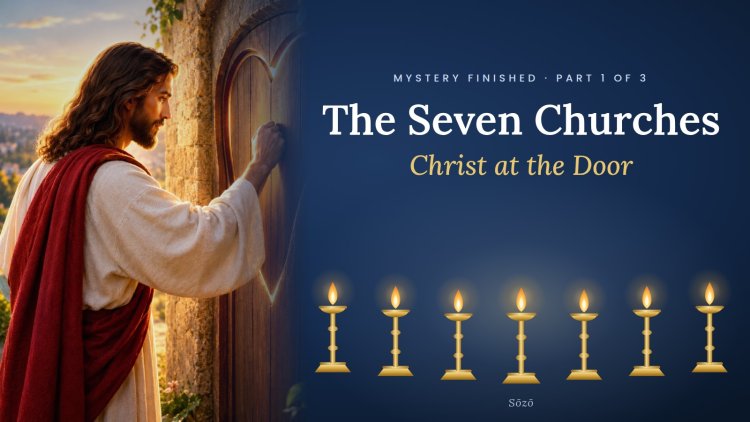
Mystery Finished · Part 1 of 3
Revelation’s seven letters end in one place: Christ at the door of the last church, offering to live His own overcoming life in His people.
“Behold, I stand at the door, and knock: if any man hear my voice, and open the door, I will come in to him, and will sup with him, and he with me. To him that overcometh will I grant to sit with me in my throne, even as I also overcame, and am set down with my Father in his throne.” (Rev. 3:20, 21)
A structure hidden in plain sight
Revelation is built, not collected. Three times John is shown a series of seven: seven churches (chapters 2–3), seven seals (6:1–8:1) and seven trumpets (8:2–11:19). Each series opens with a scene in the heavenly sanctuary: Christ walking among the golden candlesticks (1:12–20), the Lamb taking the sealed book before the throne (chapters 4–5), and an angel offering incense at the golden altar (8:3–5). As Ángel Manuel Rodríguez notes in the Handbook of Seventh-day Adventist Theology, “every one of the visionary cycles of the book is introduced by a sanctuary scene.” A century earlier, A. T. Jones saw the same design from another angle. The trumpets, he wrote, rest on “the first three steps in each of the two preceding lines of prophecy in the book of Revelation: the Seven Churches and the Seven Seals.”1
Adventists read these series the way the Reformers and the Advent pioneers read Daniel: as prophecy unfolding in order through history, from John’s day to the end. The Handbook calls this historicism, a reading that sees “a historical continuum in the biblical apocalyptic visions.”2 Prophetic time is symbolic, a day for a year (Num. 14:34; Ezek. 4:6).
Ellen White confirms that the churches are to be read this way:
“The names of the seven churches are symbolic of the church in different periods of the Christian Era. The number 7 indicates completeness, and is symbolic of the fact that the messages extend to the end of time, while the symbols used reveal the condition of the church at different periods in the history of the world.”3
So the three sevens cross the same centuries from three angles. The churches show the condition of God’s people, the seals show the conflict raging around them, and the trumpets sound heaven’s warnings to the world. Each series ends at the same place: a people in whom Christ fully lives.
The trumpets name that destination outright. When the seventh angel sounds, “the mystery of God should be finished” (Rev. 10:7), and Paul tells us what the mystery is: “Christ in you, the hope of glory” (Col. 1:27). This series follows that road, and it begins with the churches.
One question, seven times
Every letter ends with the same promise: “To him that overcometh.” Seven times, across the whole Christian era, Christ holds out the prize of victory. What it means to overcome, and how it is done, becomes clear only in the last letter, to Laodicea.
| Church | Period (approx.) | Christ’s word |
|---|---|---|
| Ephesus | A.D. 31–100 | “Thou hast left thy first love” (2:4) |
| Smyrna | c. 100–313 | “Ye shall have tribulation ten days” (2:10) |
| Pergamos | 313–538 | “Where Satan’s seat is” (2:13) |
| Thyatira | 538–1517 | “Thou sufferest that woman Jezebel” (2:20) |
| Sardis | 1517–1798 | “Thou hast a name that thou livest, and art dead” (3:1) |
| Philadelphia | 1798–1844 | “I have set before thee an open door” (3:8) |
| Laodicea | 1844 to the end | “Thou art neither cold nor hot” (3:15) |
The dates for the first three churches follow Uriah Smith’s Daniel and the Revelation, as compiled in Gems from Revelation, and A. T. Jones reads those three the same way. From Thyatira on, the article follows Adventist writers who end Thyatira and begin Sardis with the Reformation of 1517. Smith himself drew those later boundaries differently.4
Ephesus, Smyrna and Pergamos
Ephesus: first love (A.D. 31–100)
Uriah Smith dated this church “from the resurrection of Christ to the close of the first century, or to the death of the last of the apostles.”5 It was a church on fire: three thousand converted in a day (Acts 2:41), five thousand more soon after (4:4), and a movement accused of turning “the world upside down” (17:6).
Yet within a generation the warmth faded. Christ commends their labour and patience, then names the problem: “Nevertheless I have somewhat against thee, because thou hast left thy first love. Remember therefore from whence thou art fallen, and repent, and do the first works” (Rev. 2:4, 5). The love was not lost by accident; it was left. The overcomer is promised “to eat of the tree of life, which is in the midst of the paradise of God” (2:7). The road back to Eden begins with a return to first love.
Smyrna: faithful unto death (c. 100–313)
If Ephesus is love grown cool, Smyrna is love proven in the fire. Christ has no rebuke for this church, only “I know thy works, and tribulation, and poverty, (but thou art rich)” (2:9). Polycarp, the aged bishop of Smyrna, was burned in the middle of the second century. His last confession has come down to us: “Fourscore and six years have I been His servant, and He hath done me no wrong. How then can I blaspheme my King who saved me?”6
Then comes the warning: “Ye shall have tribulation ten days” (2:10). In prophetic time a day stands for a year. Uriah Smith observed that “the last and most bloody of the ten great persecutions of the Christian church continued just ten years from AD 303 to 313, beginning under Diocletian.” A. T. Jones read it the same way: “the ten years of persecution in the reign of Diocletian.”7
The Great Persecution, A.D. 303–313
- 23 February 303. Soldiers tore down the church at Nicomedia, Diocletian’s capital. The first edict was posted the next day.8
- The first edict ordered churches razed and the Scriptures burned, and stripped Christians of rank and legal protection.9 Those who handed over the Scriptures were called traditores, “those who hand over,” the root of our word traitor.
- Later in 303 the clergy were imprisoned, then offered release if they would sacrifice to the gods.10
- 304. A fourth edict required everyone to sacrifice. The persecution raged most fiercely in the East under Galerius; in the West, Constantius largely limited himself to pulling down churches.11
- An eyewitness. Eusebius, who lived through it, describes executioners in Egypt so worn out that they took turns.12
- 311. Galerius, dying, issued an edict of toleration and asked the Christians to pray for him.13
- 313. Constantine and Licinius granted Christians full freedom and restored their property.14
Ten years, almost to the year. “Be thou faithful unto death, and I will give thee a crown of life” (Rev. 2:10).
Pergamos: where Satan’s seat is (313–538)
The church that persecution could not break was nearly undone by favour. Under Constantine the faith moved from the arena to the palace, and crowds entered the church for advantage rather than conviction. Taylor G. Bunch described the period as “about 250 years, from the so-called conversion of Constantine to Justinian the Great, whose decrees made the popes the successors of the Caesars.” A. T. Jones saw in this period “the time of the making of the Papacy.”15
Christ warns against the doctrine of Balaam, who taught Israel to compromise (Rev. 2:14; Num. 25:1–3). Yet He still says, “thou holdest fast my name, and hast not denied my faith” (Rev. 2:13). A faithful remnant survived even here.
Thyatira, Sardis and Philadelphia
Thyatira: the long night (538–1517)
The longest period receives the longest letter. It opens in 538, when the Ostrogoths were driven from Rome and the papacy entered the 1,260 years of supremacy foretold in prophecy (Dan. 7:25; Rev. 12:6, 14; 13:5). Those years would run until 1798, when Napoleon’s general Berthier took Pope Pius VI prisoner, but Thyatira covers only the darkest stretch of them. As Roy Allan Anderson writes, “A change came at the end of the Thyatiran period when the great Reformation arose.”16
In these centuries Scripture was kept from ordinary people. In 1229 the Council of Toulouse forbade lay people to possess the books of the Old and New Testaments.17 Yet Christ could still say, “the last to be more than the first” (Rev. 2:19). The Waldenses kept the Scriptures alive in the Alps, Wycliffe and his followers put the Bible into English in the 1380s, and Jan Hus was burned at Constance in 1415. To Thyatira’s overcomer Christ promises “the morning star” (2:28), and the morning star is Christ Himself (22:16).
Sardis: a name to live (1517–1798)
The Reformation broke the long night, and Sardis is its church. Luther’s Ninety-five Theses of 31 October 1517 began the recovery of the truth that “the just shall live by faith” (Rom. 1:17). Tyndale gave England the New Testament and died for it in 1536. But within a few generations the churches of the Reformation had hardened into creeds.
As the Seventh-day Adventist Bible Commentary puts it, the Reformation churches had discovered what it means to live by faith in Jesus Christ, “but for the most part they eventually lapsed into a state resembling, in certain ways, that of the organization from which they had withdrawn.”18 Christ’s diagnosis fits: “thou hast a name that thou livest, and art dead… for I have not found thy works perfect before God” (Rev. 3:1, 2). The Reformation had begun, but it was never finished. Still, “Thou hast a few names even in Sardis which have not defiled their garments” (3:4). Many such hungry hearts would join the Advent awakening.
Philadelphia: the open door (1798–1844)
Philadelphia means brotherly love, and its letter carries no rebuke. These were the believers of the Advent awakening, who searched the prophecies and looked for their Lord. To them Christ says, “I have set before thee an open door, and no man can shut it: for thou hast a little strength, and hast kept my word, and hast not denied my name” (3:8).
Ellen White saw that door opened in 1844, when Christ entered the most holy place of the heavenly sanctuary.19 There the work pictured in Daniel 8:14 now goes forward.
Laodicea: the church that does not know (1844 to the end)
Now we come to ourselves. Ellen White wrote, “The message to the church of the Laodiceans is a startling denunciation, and is applicable to the people of God at the present time.”20
The city was a banking centre of the Lycus valley, known for its medical school and its eye salve. It was so wealthy that when an earthquake struck in A.D. 60, it rebuilt “by its own resources,” without help from Rome.21 Christ’s words fit it exactly: “Because thou sayest, I am rich, and increased with goods, and have need of nothing; and knowest not that thou art wretched, and miserable, and poor, and blind, and naked” (Rev. 3:17).
This is not open rebellion. It is numbness: a lukewarm church that cannot feel its own condition. Christ’s remedy is Himself: “I counsel thee to buy of me gold tried in the fire, that thou mayest be rich; and white raiment, that thou mayest be clothed… and anoint thine eyes with eyesalve, that thou mayest see” (3:18).
Frank B. Holbrook writes in the Handbook that Christ is here “calling the last stage of His church (as individuals) to surrender fully to His Lordship.” Those who heed Him “put away their known sins, and they resist the temptations that struggle for the mastery.”22
The climax: Christ at the door
Christ does not condemn Laodicea and walk away. “As many as I love, I rebuke and chasten: be zealous therefore, and repent. Behold, I stand at the door, and knock: if any man hear my voice, and open the door, I will come in to him, and will sup with him, and he with me” (Rev. 3:19, 20).
This is the answer the seven letters have been building toward. It is not a programme or a reform movement; it is Christ Himself. “Only Christ can cleanse the soul temple,” Ellen White wrote. “But He will not force an entrance.”23
The last promise is the only one that names Christ’s own victory as the pattern: “To him that overcometh will I grant to sit with me in my throne, even as I also overcame, and am set down with my Father in his throne” (3:21). Laodicea’s overcomers overcome as He overcame.
How? Scripture answers plainly:
- “I am crucified with Christ: nevertheless I live; yet not I, but Christ liveth in me: and the life which I now live in the flesh I live by the faith of the Son of God, who loved me, and gave himself for me” (Gal. 2:20).
- “Whereby are given unto us exceeding great and precious promises: that by these ye might be partakers of the divine nature, having escaped the corruption that is in the world through lust” (2 Pet. 1:4).
- “Whosoever is born of God doth not commit sin; for his seed remaineth in him: and he cannot sin, because he is born of God” (1 John 3:9).
- “He that saith he abideth in him ought himself also so to walk, even as he walked” (1 John 2:6).
- “Now unto him that is able to keep you from falling, and to present you faultless before the presence of his glory with exceeding joy” (Jude 24).
John is describing the settled direction of a life. The one in whom Christ lives does not go on in sin, because the life now at work in him is Christ’s own: “it is God which worketh in you both to will and to do of his good pleasure” (Phil. 2:13).
Ellen White confirms what the Bible establishes:
“By His perfect obedience He has made it possible for every human being to obey God’s commandments. When we submit ourselves to Christ, the heart is united with His heart, the will is merged in His will, the mind becomes one with His mind, the thoughts are brought into captivity to Him; we live His life. This is what it means to be clothed with the garment of His righteousness.”24
“Jesus revealed no qualities, and exercised no powers, that men may not have through faith in Him. His perfect humanity is that which all His followers may possess, if they will be in subjection to God as He was.”25
And commenting on Revelation 3:21 itself:
“We can overcome. Yes; fully, entirely. Jesus died to make a way of escape for us, that we might overcome every evil temper, every sin, every temptation, and sit down at last with Him.”26
Where the final generation begins
Here the seven churches meet the theme of this whole series. The last church is the church of the last generation, and to it alone Christ offers His own victory as the measure of theirs: “even as I also overcame.”
Adventist writers from M. L. Andreasen to Herbert E. Douglass and Kevin D. Paulson have taught that God will have, at the end, a people in whom the character of Christ is fully reproduced.27 Their lives will answer Satan’s charge that God’s law cannot be kept. Part 3 takes up that charge directly. For now, notice where it begins: not in a stronger human will, but at a door, with Christ coming in.
Not every Adventist scholar puts it this way. Ivan T. Blazen, writing in the Handbook, which the General Conference’s Biblical Research Institute prepared, cautions that “in neither Testament is perfection or blamelessness equated with sinlessness.”28 Those told to be perfect, he notes, are also taught to pray for forgiveness (Matt. 5:48; 6:12). That caution deserves a fair hearing, and two things can be said in reply.
- The promise is not a claim people make about themselves. “Those who are really seeking to perfect Christian character will never indulge the thought that they are sinless.”29 The overcomer is the last to boast.
- The promise rests on what Christ can do. Scripture sets no lower limit on that than His own life: He is “able to keep you from falling” (Jude 24). The same Handbook speaks of “an endtime, victorious people of God” who are “spotless” (Rev. 14:5).30
Whatever words we use, the destination is the same: Christ living His own life in His people.
Open the door
The seven churches carry one call across the whole Christian era: let Christ in, and let Him live His life in you. Ephesus needed it when its love cooled, and Smyrna when the fire came. Pergamos and Thyatira needed it when the world pressed in, and Sardis when its life drained away. Laodicea needs it most, because Laodicea does not know it needs anything.
He is still knocking: “if any man hear my voice, and open the door, I will come in to him.” The overcomer of the last generation begins exactly there.
Next, Part 2: The Seven Seals. “Who shall be able to stand?” (Rev. 6:17)

About the author
Belden Orina holds a BSc and an MSc in Computer Science from Periyar University, India, and is completing a Bachelor of Theology at Bugema University. He has a keen interest in health evangelism, lifestyle coaching and evangelistic ministry, and writes on the gospel that saves the soul and heals the body.
Notes
Scripture quotations are from the King James Version; Bible references are given in the text.
- Ángel Manuel Rodríguez, “The Sanctuary,” in Handbook of Seventh-day Adventist Theology, ed. Raoul Dederen, Commentary Reference Series 12 (Hagerstown, MD: Review and Herald, 2000), 394; A. T. Jones, The Great Nations of To-day (Battle Creek, MI: Review and Herald, 1901), 8. ↩
- Dederen, Handbook, Glossary, s.v. “Historicism.” ↩
- Ellen G. White, The Acts of the Apostles (Mountain View, CA: Pacific Press, 1911), 585. ↩
- Uriah Smith, Daniel and the Revelation (Battle Creek, MI: Review and Herald, 1897), 368–69, quoted in Patrick M. Jones, comp., Gems from Revelation (Coalmont, TN: 3 Angels Publishing, 2012), 30, 41; Taylor G. Bunch, The Seven Epistles of Christ, 150–51, quoted in Jones, Gems from Revelation, 44; A. T. Jones, Great Nations of To-day, 9–11. On Sardis as the church of the Reformation, see Roy Allan Anderson, Unfolding the Revelation, 30–31, and Francis D. Nichol, ed., The Seventh-day Adventist Bible Commentary, rev. ed. (Washington, DC: Review and Herald, 1978), 7:756, both quoted in Jones, Gems from Revelation, 55, 66. Smith instead gave Thyatira the whole period from 538 to 1798 and began Sardis “about 1798”; Smith, Daniel and the Revelation, 377, 383, quoted in Jones, Gems from Revelation, 53, 64. On Laodicea from 1844, see J. R. Zurcher, Christ of the Revelation, 56, quoted in Jones, Gems from Revelation, 83. ↩
- Smith, Daniel and the Revelation, 368, quoted in Jones, Gems from Revelation, 30. ↩
- The Martyrdom of Polycarp 9.3, in The Apostolic Fathers, trans. J. B. Lightfoot, ed. J. R. Harmer (London: Macmillan, 1891). ↩
- Smith, Daniel and the Revelation, 369, quoted in Jones, Gems from Revelation, 41; A. T. Jones, Great Nations of To-day, 10. ↩
- Lactantius, Of the Manner in Which the Persecutors Died 12–13, trans. William Fletcher, in The Ante-Nicene Fathers, ed. Alexander Roberts and James Donaldson, vol. 7 (Buffalo, NY: Christian Literature, 1886). ↩
- Eusebius, Church History 8.2.4, trans. Arthur Cushman McGiffert, in The Nicene and Post-Nicene Fathers, 2nd ser., ed. Philip Schaff and Henry Wace, vol. 1 (New York: Christian Literature, 1890). ↩
- Eusebius, Church History 8.6.8–10. ↩
- Eusebius, The Martyrs of Palestine 3.1; Lactantius, Persecutors 15. ↩
- Eusebius, Church History 8.9.4. ↩
- Eusebius, Church History 8.17.3–10; Lactantius, Persecutors 34. ↩
- Lactantius, Persecutors 48; Eusebius, Church History 10.5.2–14. ↩
- Taylor G. Bunch, The Seven Epistles of Christ, 150–51, quoted in Jones, Gems from Revelation, 44; A. T. Jones, Great Nations of To-day, 11. ↩
- Roy Allan Anderson, Unfolding the Revelation, 30–31, quoted in Jones, Gems from Revelation, 55. ↩
- Council of Toulouse (1229), canon 14. ↩
- Nichol, Seventh-day Adventist Bible Commentary, 7:756, quoted in Jones, Gems from Revelation, 66. ↩
- Ellen G. White, Early Writings (Washington, DC: Review and Herald, 1945), 42. ↩
- Ellen G. White, Testimonies for the Church (Mountain View, CA: Pacific Press, 1948), 3:252. ↩
- Tacitus, Annals 14.27, in Annals of Tacitus, trans. Alfred John Church and William Jackson Brodribb (London: Macmillan, 1895). ↩
- Frank B. Holbrook, “The Great Controversy,” in Dederen, Handbook, 996. ↩
- Ellen G. White, The Desire of Ages (Mountain View, CA: Pacific Press, 1940), 161. ↩
- Ellen G. White, Christ’s Object Lessons (Washington, DC: Review and Herald, 1941), 311. ↩
- White, Desire of Ages, 664. ↩
- White, Testimonies for the Church, 1:144. ↩
- See M. L. Andreasen, The Sanctuary Service (Washington, DC: Review and Herald, 1937), chap. “The Last Generation”; Herbert E. Douglass, Why Jesus Waits (Washington, DC: Review and Herald, 1976); and Kevin D. Paulson, What Is Last Generation Theology? (2021), summarized in “What Is Last Generation Theology?,” ADvindicate, December 10, 2021, advindicate.com. ↩
- Ivan T. Blazen, “Salvation,” in Dederen, Handbook, 298. On the Biblical Research Institute’s responsibility for the Handbook, see Dederen, “Preface,” in Handbook. ↩
- Ellen G. White, The Sanctified Life (Washington, DC: Review and Herald, 1937), 7. ↩
- Holbrook, “Great Controversy,” 996. ↩
Take it further
Did this speak to you? Ask for more, or ask us to pray with you.
Comments 0
No comments yet. Be the first to share a thought.