In the World but Not of the World
Discipleship · Faith over fear
Christians live in the same world as everyone else, with the same giants, the same storms and the same bad news. What Jesus gives them is not a calmer world but another spirit, and with it a peace the world can neither give nor take away.
“I pray not that thou shouldest take them out of the world, but that thou shouldest keep them from the evil. They are not of the world, even as I am not of the world.” (John 17:15, 16)
Kept, not removed
On the night before the cross, Jesus prayed for His disciples. Twice in that prayer He says, “They are not of the world, even as I am not of the world” (John 17:14, 16). Yet He did not ask the Father to take them out of it: “I pray not that thou shouldest take them out of the world, but that thou shouldest keep them from the evil” (17:15). In fact, He was sending them into it: “As thou hast sent me into the world, even so have I also sent them into the world” (17:18).
So the Christian lives in this world but belongs to another kingdom. Jesus said, “My kingdom is not of this world” (John 18:36). We pay the same prices, catch the same diseases, sit the same exams and hear the same news as everyone else. But Paul says, “our conversation is in heaven” (Philippians 3:20), and the word he uses means citizenship. Our address is on earth, but our citizenship is in heaven, and that is where our outlook, our courage and our peace come from.
Jesus Himself lived this way. Ellen White describes Him as “a stranger and sojourner on the earth—in the world, but not of the world; tempted and tried as men and women today are tempted and tried, yet living a life free from sin” (Testimonies for the Church, vol. 8, p. 286).
Being “not of the world” does not mean being spared its trouble. Jesus was plain about that: “In the world ye shall have tribulation: but be of good cheer; I have overcome the world” (John 16:33). The difference is not in the storm but in the spirit with which we meet it. Nowhere is that clearer than at Kadesh, on the border of the Promised Land.
Twelve spies, two reports
Moses sent twelve men, one from each tribe, to search out Canaan. They spent forty days in the land and came back with a single cluster of grapes so heavy that “they bare it between two upon a staff” (Numbers 13:23). All twelve agreed about the land: “surely it floweth with milk and honey; and this is the fruit of it” (13:27).
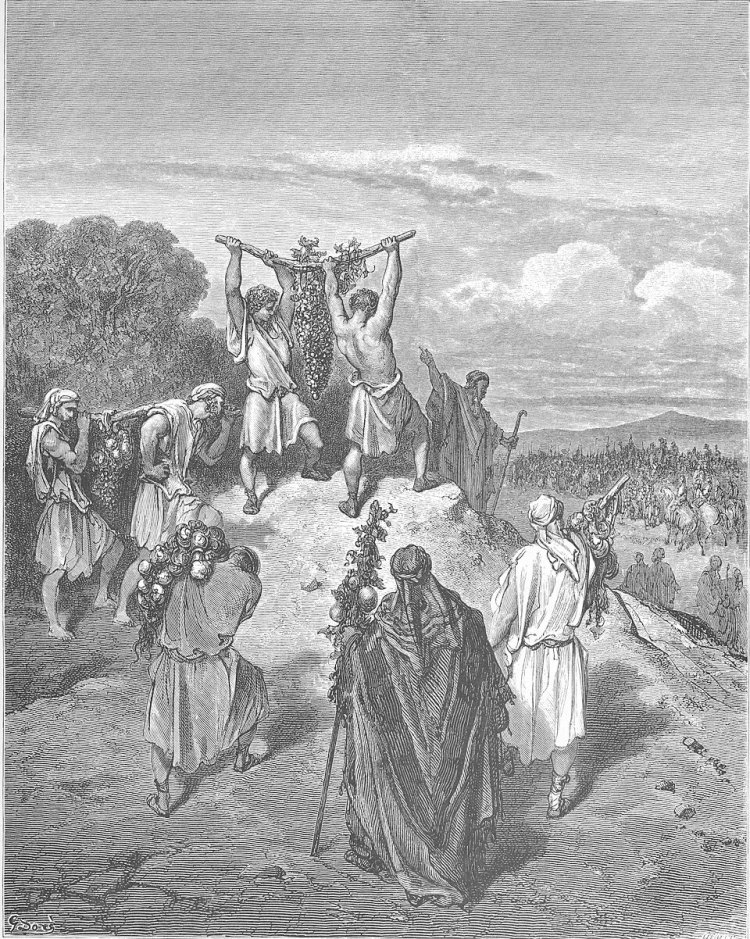
Gustave Doré, The Return of the Spies from the Land of Promise (1866). Public domain.
They also agreed about the danger, and the danger was real. “Nevertheless the people be strong that dwell in the land, and the cities are walled, and very great: and moreover we saw the children of Anak there” (13:28). This was no exaggeration. Nearly forty years later Moses himself described the same enemy: “nations greater and mightier than thyself, cities great and fenced up to heaven, A people great and tall, the children of the Anakims … Who can stand before the children of Anak!” (Deuteronomy 9:1, 2).
Ellen White notes that Caleb did not dispute the facts: “He did not contradict what had already been said; the walls were high and the Canaanites strong. But God had promised the land to Israel” (Patriarchs and Prophets, p. 388).
“As grasshoppers”
Here the twelve divided. Caleb “stilled the people before Moses, and said, Let us go up at once, and possess it; for we are well able to overcome it” (Numbers 13:30). The other ten answered, “We be not able to go up against the people; for they are stronger than we” (13:31). Then came the line that gave them away: “there we saw the giants, the sons of Anak, which come of the giants: and we were in our own sight as grasshoppers, and so we were in their sight” (13:33).
Notice where the defeat happened: “in our own sight.” The ten were beaten before a single arrow was fired. They had measured the giants against themselves. Joshua and Caleb measured the giants against God: “If the LORD delight in us, then he will bring us into this land, and give it us … neither fear ye the people of the land; for they are bread for us: their defence is departed from them, and the LORD is with us: fear them not” (14:8, 9).
Same land, same walls, same giants, and two completely different reports. The people believed the ten. “All the congregation lifted up their voice, and cried; and the people wept that night” (14:1). They murmured against Moses and Aaron and said to one another, “Let us make a captain, and let us return into Egypt” (14:4). Moses and Aaron fell on their faces before the whole assembly (14:5). Joshua and Caleb tore their clothes in grief (14:6) and begged the people not to rebel against the LORD (14:9).
The crowd answered with stones. “But all the congregation bade stone them with stones” (14:10). The whole nation of Israel called for Joshua and Caleb, the only two spies who had brought back a good report, to be stoned to death. They were stopped only when “the glory of the LORD appeared in the tabernacle of the congregation before all the children of Israel” (14:10).
“Another spirit”
God’s verdict singled out one man: “But my servant Caleb, because he had another spirit with him, and hath followed me fully, him will I bring into the land whereinto he went; and his seed shall possess it” (Numbers 14:24).
Caleb walked the same roads as the ten, saw the same fortified cities and stood in the same frightened camp. But he did not share its spirit. The spirit of the ten was unbelief: “So we see that they could not enter in because of unbelief” (Hebrews 3:19). Caleb was in the camp, but he was not of the camp.
In the world, but not of the world.
And Caleb had read the situation more accurately than the “realists.” Years later a woman of Jericho told Joshua’s spies what the Canaanites had been feeling ever since they heard “how the LORD dried up the water of the Red sea for you, when ye came out of Egypt” (Joshua 2:10). “Your terror is fallen upon us,” she said, “and … all the inhabitants of the land faint because of you” (2:9). “As soon as we had heard these things, our hearts did melt, neither did there remain any more courage in any man, because of you” (2:11). The giants were afraid of the grasshoppers. Caleb’s words, “their defence is departed from them,” had been true all along. Faith had seen what sight missed.
How the story ended
The two reports led to two very different endings. “Even those men that did bring up the evil report upon the land, died by the plague before the LORD” (Numbers 14:37). The generation that believed them wandered in the wilderness forty years, “each day for a year” (14:34), until they died there. “But Joshua the son of Nun, and Caleb the son of Jephunneh, which were of the men that went to search the land, lived still” (14:38).
Joshua led the next generation over the Jordan. The first walled city they faced was Jericho, and “the wall fell down flat” (Joshua 6:20). Cities “fenced up to heaven” were no match for the God of heaven. Joshua died at a hundred and ten, “the servant of the LORD” (Joshua 24:29), after setting a choice before the nation and making his own: “as for me and my house, we will serve the LORD” (24:15).
Caleb’s ending is even more striking. At eighty-five he came to Joshua and said, “As yet I am as strong this day as I was in the day that Moses sent me … Now therefore give me this mountain” (Joshua 14:11, 12). The mountain was Hebron, the very place where the spies had first seen “Ahiman, Sheshai, and Talmai, the children of Anak” (Numbers 13:22). And “Caleb drove thence the three sons of Anak, Sheshai, and Ahiman, and Talmai” (Joshua 15:14). The giants who had made ten men feel like grasshoppers fell before an old man who believed God.
“Caleb’s faith now was just what it was when his testimony had contradicted the evil report of the spies. … He did not ask for himself a land already conquered, but the place which above all others the spies had thought it impossible to subdue. By the help of God he would wrest his stronghold from the very giants whose power had staggered the faith of Israel.” (Patriarchs and Prophets, p. 512)
The giants did not decide how the story ended. The spirit did.
Peace that stands guard
Our giants have other names: the high cost of living, sickness and pestilence, heartbreak, a lost job, exam pressure, political unrest, persecution, an uncertain future, death itself, and ahead of us the final crisis of earth’s history. The world looks at them and trembles. The Christian looks at the same facts with another spirit.
Paul put it in one instruction: “Be careful for nothing; but in every thing by prayer and supplication with thanksgiving let your requests be made known unto God. And the peace of God, which passeth all understanding, shall keep your hearts and minds through Christ Jesus” (Philippians 4:6, 7). In the English of the King James Version, “careful” means full of care, that is, anxious. And the word translated “keep” is a military word. Paul used it for the garrison that guarded Damascus (2 Corinthians 11:32). The peace of God stands guard over the heart.
Paul did not write those words in comfort. He wrote them in chains (Philippians 1:13).
This peace is not the kind the world offers. Jesus said, “Peace I leave with you, my peace I give unto you: not as the world giveth, give I unto you. Let not your heart be troubled, neither let it be afraid” (John 14:27). The world’s peace depends on circumstances. Christ’s peace does not. Even our peace is not of the world.
Ellen White invites us to bring every care to God:
“Keep your wants, your joys, your sorrows, your cares, and your fears before God. You cannot burden Him; you cannot weary Him. … Nothing that in any way concerns our peace is too small for Him to notice.” (Steps to Christ, p. 100)
Asleep in the storm
Jesus showed us what this peace looks like. On the Sea of Galilee “there arose a great storm of wind, and the waves beat into the ship, so that it was now full. And he was in the hinder part of the ship, asleep on a pillow” (Mark 4:37, 38). The disciples woke Him: “Master, carest thou not that we perish?” (4:38). He calmed the sea, and then He asked them, “Why are ye so fearful? how is it that ye have no faith?” (4:40).
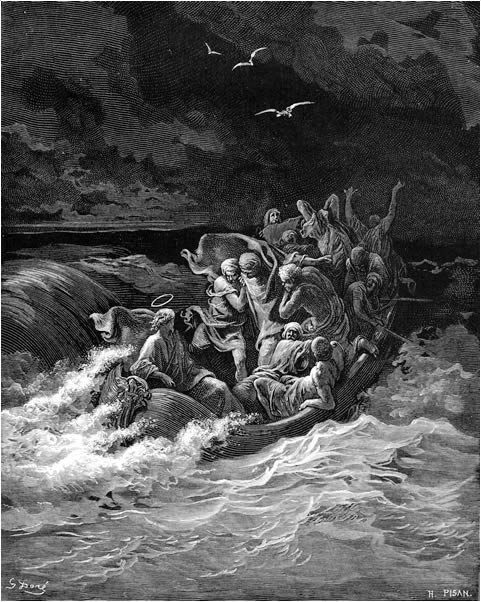
Gustave Doré, Jesus Stilling the Tempest (1866). Public domain.
“When Jesus was awakened to meet the storm, He was in perfect peace. There was no trace of fear in word or look, for no fear was in His heart. … It was in faith—faith in God’s love and care—that Jesus rested, and the power of that word which stilled the storm was the power of God. As Jesus rested by faith in the Father’s care, so we are to rest in the care of our Saviour.” (The Desire of Ages, p. 336)
Same storm, another spirit
Christ’s followers have shown this peace in every age.
The Moravians sang on
In 1735 John and Charles Wesley sailed for the American colony of Georgia as missionaries. Ellen White tells what happened on the voyage:
“John and Charles Wesley, after being ordained to the ministry, were sent on a mission to America. On board the ship was a company of Moravians. Violent storms were encountered on the passage, and John Wesley, brought face to face with death, felt that he had not the assurance of peace with God. The Germans, on the contrary, manifested a calmness and trust to which he was a stranger.”
She then quotes Wesley’s own account:
“I had long before,” he says, “observed the great seriousness of their behavior. Of their humility they had given a continual proof, by performing those servile offices for the other passengers which none of the English would undertake; for which they desired and would receive no pay, saying it was good for their proud hearts, and their loving Saviour had done more for them. And every day had given them occasion of showing a meekness which no injury could move. If they were pushed, struck, or thrown down, they rose again and went away; but no complaint was found in their mouth. There was now an opportunity of trying whether they were delivered from the spirit of fear, as well as from that of pride, anger, and revenge. In the midst of the psalm wherewith their service began, the sea broke over, split the mainsail in pieces, covered the ship, and poured in between the decks as if the great deep had already swallowed us up. A terrible screaming began among the English. The Germans calmly sang on. I asked one of them afterwards, ‘Were you not afraid?’ He answered, ‘I thank God, no.’ I asked, ‘But were not your women and children afraid?’ He replied mildly, ‘No; our women and children are not afraid to die.’” (The Great Controversy, pp. 254, 255)
Notice where the Moravians’ courage came from. Long before the storm, Christ had freed them from pride, anger and revenge. They did the lowliest work on board without pay, “saying it was good for their proud hearts, and their loving Saviour had done more for them.” The storm only tested what grace had already done. Hearts that had been delivered from pride were delivered from “the spirit of fear” as well.
Wesley was an ordained minister on his way to the mission field, yet he had religion without peace. The calm of those German believers set him searching until he found it, when, in his own words, he could “trust in Christ, Christ alone, for salvation” (The Great Controversy, p. 255). Peace does not come from a calm sea. It comes from trusting the One who rules the sea. “For God hath not given us the spirit of fear; but of power, and of love, and of a sound mind” (2 Timothy 1:7).
The same ship carried them all through the same storm. On one side there was screaming; on the other, a psalm.
In the world, but not of the world.
Sleeping the night before execution
Herod had just “killed James the brother of John with the sword” (Acts 12:2). Seeing that it pleased the people, he arrested Peter, “intending after Easter to bring him forth to the people” (12:4). Everyone knew what that meant. Yet “the same night Peter was sleeping between two soldiers, bound with two chains” (12:6). The angel sent to free him had to strike him on the side to wake him (12:7).
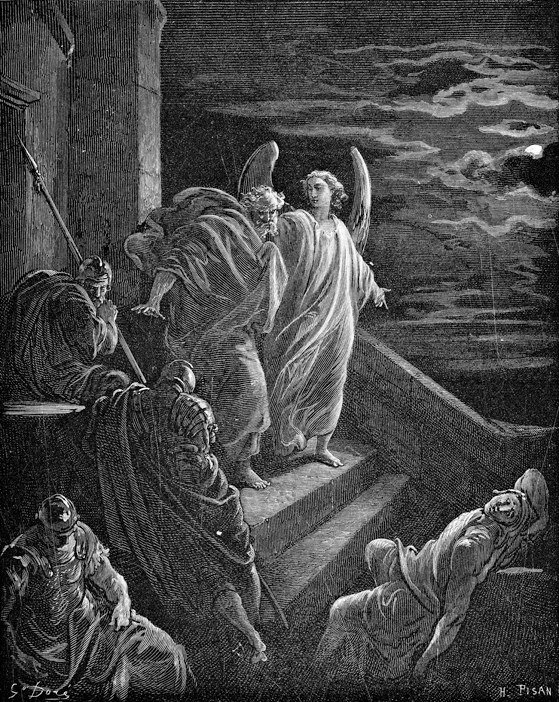
Gustave Doré, St. Peter Delivered from Prison (1866). Public domain.
Ellen White notes that Herod had taken double precautions. Sixteen soldiers guarded Peter day and night. “But man’s extremity is God’s opportunity” (The Acts of the Apostles, p. 145). When the angel entered the cell, “there lies Peter, sleeping the peaceful sleep of perfect trust” (p. 146).
This was the same Peter who once began to sink when “he saw the wind boisterous” and “was afraid” (Matthew 14:30). Now, on what might have been the last night of his life, he slept like a child. David knew that rest: “I will both lay me down in peace, and sleep: for thou, LORD, only makest me dwell in safety” (Psalm 4:8).
Rejoicing after a beating
When the council had the apostles beaten and ordered them not to speak in the name of Jesus, they “departed from the presence of the council, rejoicing that they were counted worthy to suffer shame for his name” (Acts 5:41). And “daily in the temple, and in every house, they ceased not to teach and preach Jesus Christ” (5:42). The world counts a public beating as disgrace. They counted it an honour.
They had been taught to expect it. In the Sermon on the Mount, near the start of His ministry, Jesus ended the Beatitudes with a blessing the world would never think of: “Blessed are ye, when men shall revile you, and persecute you, and shall say all manner of evil against you falsely, for my sake. Rejoice, and be exceeding glad: for great is your reward in heaven: for so persecuted they the prophets which were before you” (Matthew 5:11, 12). On the night before the cross He told them why it would happen: “If ye were of the world, the world would love his own: but because ye are not of the world, but I have chosen you out of the world, therefore the world hateth you” (John 15:19). Persecution is the world’s answer to people who are not of it. The apostles took their stripes as proof that they belonged to Christ.
Songs at midnight
At Philippi, Paul and Silas were stripped, beaten with rods and thrown into the inner prison, where the jailer “made their feet fast in the stocks” (Acts 16:24). “And at midnight Paul and Silas prayed, and sang praises unto God: and the prisoners heard them” (16:25).
“The apostles suffered extreme torture because of the painful position in which they were left, but they did not murmur. Instead, in the utter darkness and desolation of the dungeon, they encouraged each other by words of prayer and sang praises to God because they were found worthy to suffer shame for His sake.” (The Acts of the Apostles, p. 213)
The other prisoners had never heard anything like it. They “marveled and asked themselves who these men could be, who, cold, hungry, and tortured, could yet rejoice” (p. 214). Before morning the jailer was asking, “Sirs, what must I do to be saved?” (Acts 16:30), and he and his household were baptized (16:33).
Peace in the storm is a powerful witness. Years later Paul wrote to that same church at Philippi, again from prison, “Be careful for nothing” (Philippians 4:6). He had lived it in their city.
Paul and Silas were in the dungeon, but the dungeon was not in them.
In the world, but not of the world.
The same spirit in every age
Scripture is full of such people. Three young Hebrews faced the furnace saying, “our God whom we serve is able to deliver us … But if not, be it known unto thee, O king, that we will not serve thy gods” (Daniel 3:17, 18). When Daniel knew the decree against prayer was signed, “he kneeled upon his knees three times a day, and prayed, and gave thanks before his God, as he did aforetime” (Daniel 6:10). Habakkuk looked at failed crops and empty stalls and said, “Yet I will rejoice in the LORD, I will joy in the God of my salvation” (Habakkuk 3:18). Paul summed it up: “We are troubled on every side, yet not distressed; we are perplexed, but not in despair; Persecuted, but not forsaken; cast down, but not destroyed” (2 Corinthians 4:8, 9). And the psalmist sang, “God is our refuge and strength, a very present help in trouble. Therefore will not we fear, though the earth be removed” (Psalm 46:1, 2).
“After all these things do the Gentiles seek”
In the Sermon on the Mount, Jesus keeps drawing a line between His followers and the world around them:
- In love: “if ye love them which love you, what reward have ye? do not even the publicans the same? … what do ye more than others?” (Matthew 5:46, 47).
- In prayer: “use not vain repetitions, as the heathen do … Be not ye therefore like unto them: for your Father knoweth what things ye have need of, before ye ask him” (6:7, 8).
- In worry: “Therefore take no thought, saying, What shall we eat? or, What shall we drink? or, Wherewithal shall we be clothed? (For after all these things do the Gentiles seek:) for your heavenly Father knoweth that ye have need of all these things” (6:31, 32).
- In leadership: “Ye know that the princes of the Gentiles exercise dominion over them … But it shall not be so among you” (20:25, 26).
The pattern is the same each time. This is how the world lives, “but it shall not be so among you.” Notice that worry is on the list. Anxiety about food, drink and clothing is the way of the Gentiles, people who do not know a Father in heaven. The disciple has a Father who “knoweth.”
So Jesus says, “Take no thought for your life” (6:25). Look at the birds: “your heavenly Father feedeth them. Are ye not much better than they?” (6:26). Look at the lilies: “shall he not much more clothe you, O ye of little faith?” (6:30). Worry adds nothing: “Which of you by taking thought can add one cubit unto his stature?” (6:27). Instead, “seek ye first the kingdom of God, and his righteousness; and all these things shall be added unto you. Take therefore no thought for the morrow” (6:33, 34).
Ellen White explains why worry makes no sense for a child of God:
“Worry is blind, and cannot discern the future; but Jesus sees the end from the beginning. In every difficulty He has His way prepared to bring relief. Our heavenly Father has a thousand ways to provide for us, of which we know nothing. Those who accept the one principle of making the service and honor of God supreme will find perplexities vanish, and a plain path before their feet.” (The Desire of Ages, p. 330)
In the same paragraph she names the root of much of our anxiety: “There are many whose hearts are aching under a load of care because they seek to reach the world’s standard. They have chosen its service, accepted its perplexities, adopted its customs” (p. 330). Much of our worry is simply the world getting into us. “If you have given yourself to God, to do His work, you have no need to be anxious for tomorrow. He whose servant you are, knows the end from the beginning” (Thoughts From the Mount of Blessing, p. 100).
Worry is not harmless, either. “The continual worry is wearing out the life forces,” Ellen White warns (The Desire of Ages, p. 330). Elsewhere she writes, “The relation that exists between the mind and the body is very intimate. … Grief, anxiety, discontent, remorse, guilt, distrust, all tend to break down the life forces and to invite decay and death” (The Ministry of Healing, p. 241). Solomon said it long ago: “A merry heart doeth good like a medicine: but a broken spirit drieth the bones” (Proverbs 17:22). The peace of God heals the body as well as the soul.
The opposite of faith
We often say that the opposite of faith is doubt. Jesus more often set faith against fear. “Why are ye so fearful? how is it that ye have no faith?” (Mark 4:40). “Be not afraid, only believe” (Mark 5:36). Ellen White says of the disciples in the storm, “Their fear in the time of danger revealed their unbelief” (The Desire of Ages, p. 336).
Fear feeds on what we see. Peter walked on the water until “he saw the wind boisterous” (Matthew 14:30). The ten spies looked at the giants and became grasshoppers “in our own sight.” The Christian lives another way: “For we walk by faith, not by sight” (2 Corinthians 5:7). The worldling lives by sight, by what he can see, count and control. The believer lives by faith, which is “the evidence of things not seen” (Hebrews 11:1). Moses “endured, as seeing him who is invisible” (Hebrews 11:27).
When the Syrian army surrounded Dothan, Elisha’s servant cried, “Alas, my master! how shall we do?” Elisha answered, “Fear not: for they that be with us are more than they that be with them,” and prayed, “LORD, I pray thee, open his eyes, that he may see.” Then the young man saw that “the mountain was full of horses and chariots of fire round about Elisha” (2 Kings 6:15–17). The ten spies saw only giants. Caleb saw God.
What, then, is faith? Ellen White gives a simple definition:
“Faith is trusting God—believing that He loves us and knows best what is for our good. Thus, instead of our own, it leads us to choose His way. In place of our ignorance, it accepts His wisdom; in place of our weakness, His strength; in place of our sinfulness, His righteousness.” (Education, p. 253)
Faith does not deny the storm. Caleb never denied the walls. Faith rests confidingly in God whatever the outlook, because it knows that He loves us and knows what is best.
Perfect peace
Resting in Him brings peace. “Thou wilt keep him in perfect peace, whose mind is stayed on thee: because he trusteth in thee” (Isaiah 26:3). In Hebrew, “perfect peace” is simply “peace, peace” (shalom shalom). It belongs to the mind that is “stayed,” leaning its whole weight on God. “Great peace have they which love thy law: and nothing shall offend them” (Psalm 119:165). Nothing will make them stumble.
But Isaiah describes another kind of person. “There is no peace, saith the LORD, unto the wicked” (Isaiah 48:22). “But the wicked are like the troubled sea, when it cannot rest, whose waters cast up mire and dirt. There is no peace, saith my God, to the wicked” (57:20, 21).
Look at the picture. In Mark 4 the disciples were in a storm, and Jesus brought them peace. In Isaiah 57 the wicked are the storm. The restless sea is inside them, always churning, always casting up mire. A ship is made to sail on the sea, and it sinks only when the sea gets into the ship. The Christian is in the world as a ship is in the water. The danger is not that we are in the world, but that the world gets into us.
In the world, but not of the world
The ten spies and the two saw the same giants. The English passengers and the Moravians rode out the same storm. Peter slept in the cell where Herod meant to keep him until his execution. Paul and Silas sang in the same dungeon that held the other prisoners. In every case the circumstances were the same. The spirit was different.
Jesus has not promised to take you out of the world. He has prayed that you will be kept in it: “I pray not that thou shouldest take them out of the world, but that thou shouldest keep them from the evil” (John 17:15). Your giants may be real. Your storm may be real. But you can have another spirit. You can bring your cares to God in prayer and let His peace stand guard over your heart. You can sleep the sleep of perfect trust, and sing at midnight.
Lord, I live in the world, and its storms are real. Keep me from its fear. Give me Caleb’s spirit, the Moravians’ song and Peter’s rest. Let Your peace guard my heart, and keep my mind stayed on You.
In the world, but not of the world.
“They are not of the world, even as I am not of the world.” (John 17:16)

About the author
Belden Orina holds a BSc and an MSc in Computer Science from Periyar University, India, and is completing a Bachelor of Theology at Bugema University. He has a keen interest in health evangelism, lifestyle coaching and evangelistic ministry, and writes on the gospel that saves the soul and heals the body.
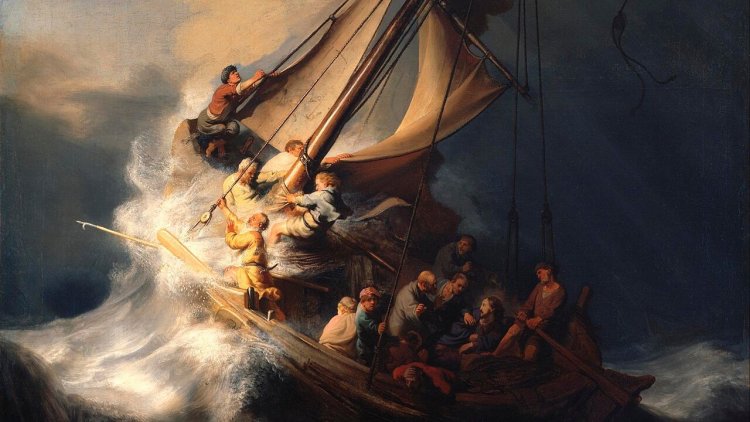
Cover: Rembrandt van Rijn, The Storm on the Sea of Galilee (1633), detail. Public domain.
References
Scripture quotations are from the King James Version.
-
Ellen G. White, Patriarchs and Prophets (1890), pp. 388, 512.
-
Ellen G. White, Steps to Christ (1892), p. 100.
-
Ellen G. White, Thoughts From the Mount of Blessing (1896), p. 100.
-
Ellen G. White, The Desire of Ages (1898), pp. 330, 336.
-
Ellen G. White, Education (1903), p. 253.
-
Ellen G. White, Testimonies for the Church, vol. 8 (1904), p. 286.
-
Ellen G. White, The Ministry of Healing (1905), p. 241.
-
Ellen G. White, The Acts of the Apostles (1911), pp. 145, 146, 213, 214.
-
Ellen G. White, The Great Controversy (1911), pp. 254, 255.
Ellen G. White’s writings can be read free at EGW Writings.
Take it further
Did this speak to you? Ask for more, or ask us to pray with you.
Comments 0
No comments yet. Be the first to share a thought.