Out of the Winepress

Discipleship
Gideon was hiding when God called him a mighty man of valour. God sees in you what He will make of you, and He is calling you out of hiding and into His work.
“And the angel of the LORD appeared unto him, and said unto him, The LORD is with thee, thou mighty man of valour.” (Judges 6:12)
A man in a hole
For seven years Midian had stripped Israel bare. Every harvest the raiders came back, “as grasshoppers for multitude” (Judges 6:5). God’s people had made themselves “the dens which are in the mountains, and caves” (6:2). They were alive, but they were hiding.
That is where we meet Gideon. He “threshed wheat by the winepress, to hide it from the Midianites” (6:11). Wheat is threshed on an open hilltop, where the wind can carry the chaff away. A winepress is a pit cut into the rock. Gideon was beating out a little grain in a hole in the ground, glancing over his shoulder.
Ellen White fills in the scene. Not daring to use the ordinary threshing floor, he had gone to the winepress, because nobody watched the vineyards so long before harvest. “As Gideon labored in secrecy and silence, he sadly pondered upon the condition of Israel and considered how the oppressor’s yoke might be broken from off his people” (Patriarchs and Prophets, p. 546).
Many young people are threshing in winepresses today. They have gifts no one sees, a faith they keep private and a burden for their friends they never voice. They feel too young, too poor, too unqualified, or too stained by the past. Like Gideon, they care, but they are hiding.
“Thou mighty man of valour”
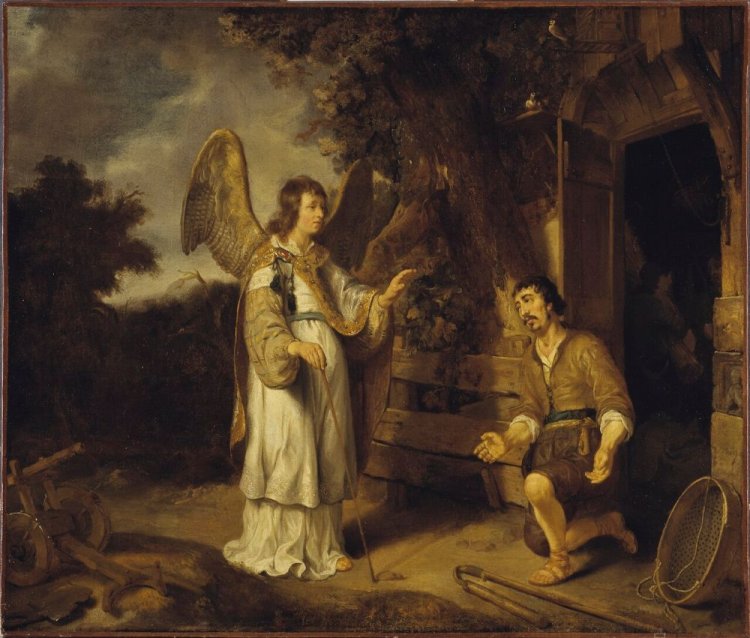
Gerbrand van den Eeckhout, The Angel and Gideon (1640). Nationalmuseum, Stockholm. Public domain.
Then heaven speaks into the pit: “The LORD is with thee, thou mighty man of valour” (Judges 6:12). The words do not seem to fit. A mighty man of valour, hiding in a winepress?
They fit, because God does not see us the way we see ourselves. He sees us for what He will do in us. “For the LORD seeth not as man seeth; for man looketh on the outward appearance, but the LORD looketh on the heart” (1 Samuel 16:7). He called Abram “a father of many nations” before Isaac was born (Genesis 17:5). He named Simon “A stone” long before Pentecost made him one (John 1:42). God “calleth those things which be not as though they were” (Romans 4:17), and “he which hath begun a good work in you will perform it until the day of Jesus Christ” (Philippians 1:6).
Ellen White saw it in Gideon. “He thought himself the least in his father’s house. But God saw in him a man of courage and integrity” (Patriarchs and Prophets, p. 553).
Gideon’s first reply was not faith but a complaint: “if the LORD be with us, why then is all this befallen us?” (6:13). God did not argue with him. He gave him a mission. Your questions do not disqualify you either. The God who calls you is big enough for them.
The Angel who is the LORD
Watch how the story names the visitor. He arrives as “an angel of the LORD” (Judges 6:11). Then, in verse 14, “the LORD looked upon him.” In verses 16 and 23 it is again “the LORD” who speaks. When Gideon understands who has been sitting under his oak, he cries out, “Alas, O LORD God! for because I have seen an angel of the LORD face to face” (6:22). The answer comes: “Peace be unto thee; fear not: thou shalt not die” (6:23). Gideon builds an altar and calls it Jehovahshalom, “the LORD is peace” (6:24).
This Angel had spoken in Judges before: “I made you to go up out of Egypt … I will never break my covenant with you” (Judges 2:1). Gideon had just asked, “Did not the LORD bring us up from Egypt?” (6:13). The One who did it was standing in front of him.
Ellen White calls Him “the Covenant Angel, who in time past had wrought for Israel” (Patriarchs and Prophets, p. 547). She also tells us who that Angel is: “Christ was not only the leader of the Hebrews in the wilderness—the Angel in whom was the name of Jehovah, and who, veiled in the cloudy pillar, went before the host—but it was He who gave the law to Israel” (Patriarchs and Prophets, p. 366; compare Exodus 23:20, 21).
The One who called Gideon out of the winepress was Jesus Christ. He is the same One calling you.
“Go in this thy might”
“Go in this thy might, and thou shalt save Israel from the hand of the Midianites: have not I sent thee?” (Judges 6:14).
What might? Gideon had a little hidden wheat, a heart that grieved for his people, and his two hands. God did not wait for him to become someone else. He told him to go with what he had, because the strength of the mission lay in the Sender: “have not I sent thee?”
You have something too. “The manifestation of the Spirit is given to every man to profit withal” (1 Corinthians 12:7). “As every man hath received the gift, even so minister the same one to another” (1 Peter 4:10). The talents were given “to every man according to his several ability” (Matthew 25:15), and the Master gave “to every man his work” (Mark 13:34). None of us is useless in the fulfilment of God’s purposes. Ellen White puts it this way:
“Each has his place in the eternal plan of heaven. Each is to work in co-operation with Christ for the salvation of souls. Not more surely is the place prepared for us in the heavenly mansions than is the special place designated on earth where we are to work for God.” (Christ’s Object Lessons, pp. 326, 327)
Your voice, your phone, your classroom, your skill, and your enterprise can all be put in His hands. And there is no ceiling on what He can do with them:
“There is no limit to the usefulness of one who, putting self aside, makes room for the working of the Holy Spirit upon his heart and lives a life wholly consecrated to God. … Through the grace given us we may achieve victories that because of our own erroneous and preconceived opinions, our defects of character, our smallness of faith, have seemed impossible.” (The Ministry of Healing, p. 159)
“I am the least”
Gideon tried one more objection: “Oh my Lord, wherewith shall I save Israel? behold, my family is poor in Manasseh, and I am the least in my father’s house” (Judges 6:15). God did not argue with his résumé. He replaced it: “Surely I will be with thee, and thou shalt smite the Midianites as one man” (6:16). Gideon would defeat the entire Midianite army as easily and completely as if he were fighting just one man. The vast enemy force (Judges 7:12 compares them to grasshoppers for multitude) would fall at once and without real difficulty, because God was with him.
It is the answer God has always given. Moses asked, “Who am I, that I should go unto Pharaoh?” and heard, “Certainly I will be with thee” (Exodus 3:11, 12). Jeremiah protested, “I cannot speak: for I am a child,” and God replied, “Say not, I am a child … for I am with thee to deliver thee” (Jeremiah 1:6–8). Paul learned, “My grace is sufficient for thee: for my strength is made perfect in weakness” (2 Corinthians 12:9). It is often said that God does not call the qualified; He qualifies the called. Ellen White says it better:
“God does not always choose for His work men of the greatest talents, but He selects those whom He can best use. … The Lord can work most effectually through those who are most sensible of their own insufficiency, and who will rely upon Him as their leader and source of strength. He will make them strong by uniting their weakness to His might, and wise by connecting their ignorance with His wisdom.” (Patriarchs and Prophets, p. 553)
God is patient with fear
Gideon did not stop being afraid overnight. His first assignment was at home: to throw down his father’s altar to Baal. He obeyed, but “because he feared his father’s household, and the men of the city, that he could not do it by day, that he did it by night” (6:27). Before the battle he asked for a sign with a fleece, then asked again with the sign reversed (6:36–40). Ellen White notes that he pleaded “that his extreme caution might not displease the Lord. His request was granted” (Patriarchs and Prophets, p. 548). On the night of the battle God Himself said, “if thou fear to go down, go thou with Phurah thy servant” (7:10).
God did not wait for Gideon to stop being afraid. He walked him through his fear, one step of obedience at a time. Then “the Spirit of the LORD came upon Gideon” (6:34). Literally, the Spirit clothed Himself with Gideon. That is, the Spirit took hold of Gideon and empowered him from within. “For God hath not given us the spirit of fear; but of power, and of love, and of a sound mind” (2 Timothy 1:7).
“God takes men as they are, and educates them for His service, if they will yield themselves to Him. … The weak, vacillating character becomes changed to one of strength and steadfastness.” (The Desire of Ages, p. 251)
Three hundred are enough
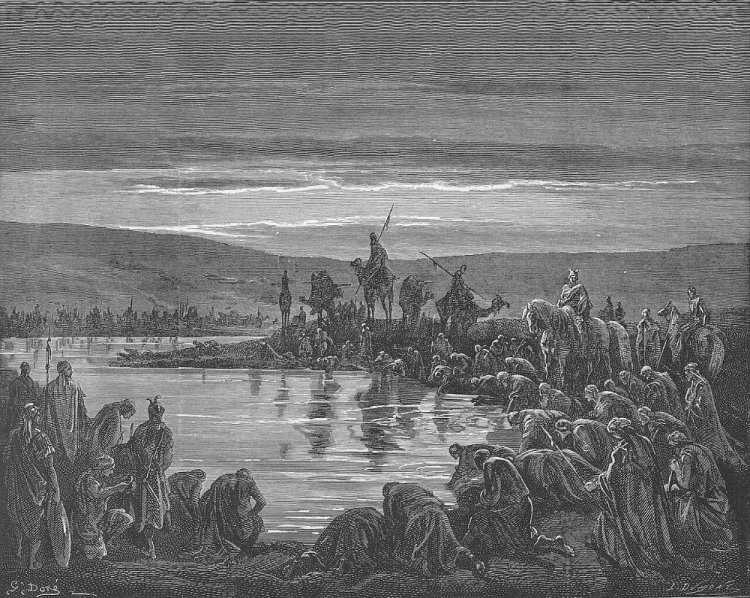
Gustave Doré, Gideon Chooses Three Hundred Soldiers (1866). Public domain.
Gideon gathered thirty-two thousand men, and God said it was too many: “The people that are with thee are too many for me to give the Midianites into their hands, lest Israel vaunt themselves against me, saying, Mine own hand hath saved me” (Judges 7:2). First the fearful were sent home: “Whosoever is fearful and afraid, let him return” (7:3). Twenty-two thousand left. Then God tested the ten thousand at the water, and only three hundred remained (7:4–7).
Ellen White explains the test:
“By the simplest means character is often tested. Those who in time of peril were intent upon supplying their own wants were not the men to be trusted in an emergency. The Lord has no place in His work for the indolent and self-indulgent. … Success does not depend upon numbers. God can deliver by few as well as by many. He is honored not so much by the great numbers as by the character of those who serve Him.” (Patriarchs and Prophets, p. 549)
God does not need a crowd. He needs a willing few.
A barley loaf
That night God sent Gideon to listen at the edge of the enemy camp. A Midianite was telling a dream: “a cake of barley bread tumbled into the host of Midian” and flattened a tent (7:13). His friend knew at once what it meant: “This is nothing else save the sword of Gideon” (7:14). Barley was the poor man’s bread. The man whose family was “poor in Manasseh” was already the terror of Midian’s camp. The enemy had seen what God saw.
Broken pitchers
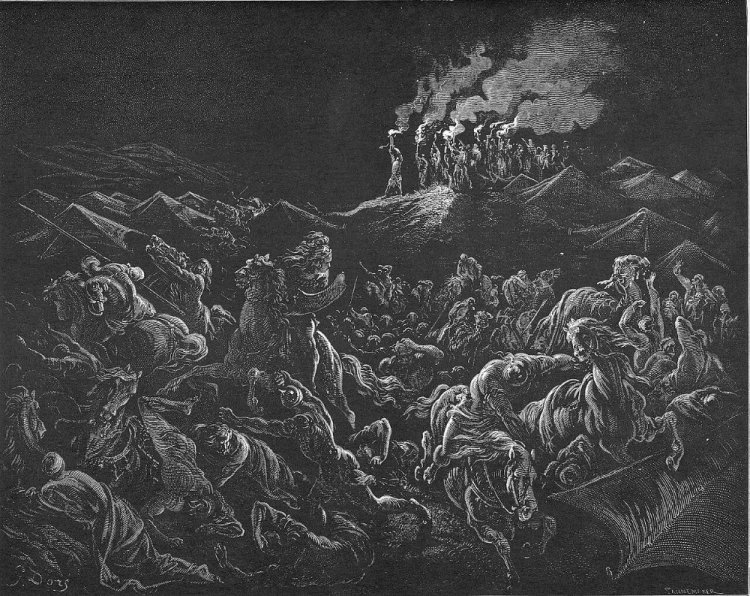
Gustave Doré, The Midianites Are Routed (1866). Public domain.
Gideon gave the three hundred “a trumpet in every man’s hand, with empty pitchers, and lamps within the pitchers” (7:16). His order was simple: “Look on me, and do likewise” (7:17). At his signal they blew the trumpets and smashed the pitchers, and the hidden torches blazed out on every side of the camp. Ellen White describes the moment: “breaking their pitchers and displaying the blazing torches, they rushed upon the enemy with the terrible war cry, ‘The sword of the Lord, and of Gideon!’” (Patriarchs and Prophets, p. 550). Then “the LORD set every man’s sword against his fellow” (7:22), and the camp collapsed.
The light shone only when the pitchers broke. Paul uses the same picture: “we have this treasure in earthen vessels, that the excellency of the power may be of God, and not of us” (2 Corinthians 4:7). The light of Christ shines brightest in a young life when self is broken and put aside. Notice, too, the order of the battle cry: the LORD first, Gideon second. It was God’s sword in Gideon’s hands. “Not by might, nor by power, but by my spirit, saith the LORD of hosts” (Zechariah 4:6).
Hebrews names Gideon among the heroes of faith, those who “out of weakness were made strong, waxed valiant in fight, turned to flight the armies of the aliens” (Hebrews 11:32, 34). The man hiding in the winepress had become what God called him: a mighty man of valour.
An army of youth to finish the work
Midian still camps in the valley. Jesus said, “this gospel of the kingdom shall be preached in all the world for a witness unto all nations; and then shall the end come” (Matthew 24:14). He also said, “The harvest truly is plenteous, but the labourers are few” (Matthew 9:37). God has promised that “he will finish the work, and cut it short in righteousness” (Romans 9:28). Once again He is gathering an army, and once again He is not looking for the strongest or the most qualified. He is looking for the willing.
Ellen White saw young people at the front of that army:
“With such an army of workers as our youth, rightly trained, might furnish, how soon the message of a crucified, risen, and soon-coming Saviour might be carried to the whole world! How soon might the end come—the end of suffering and sorrow and sin!” (Education, p. 271)
“The Lord has appointed the youth to be His helping hand” (Testimonies for the Church, vol. 7, p. 64). “We have an army of youth today who can do much if they are properly directed and encouraged” (Christian Service, p. 30). And the work will not be finished by pastors alone: “The work of God in this earth can never be finished until the men and women comprising our church membership rally to the work and unite their efforts with those of ministers and church officers” (Testimonies for the Church, vol. 9, pp. 116, 117).
Scripture does not tell young people to wait their turn. “Let no man despise thy youth; but be thou an example of the believers, in word, in conversation, in charity, in spirit, in faith, in purity” (1 Timothy 4:12). “I have written unto you, young men, because ye are strong, and the word of God abideth in you, and ye have overcome the wicked one” (1 John 2:14).
What God looks for first is not talent but character:
“The greatest want of the world is the want of men—men who will not be bought or sold, men who in their inmost souls are true and honest, men who do not fear to call sin by its right name, men whose conscience is as true to duty as the needle to the pole, men who will stand for the right though the heavens fall.” (Education, p. 57)
Adventist young people have long carried this call in their own words. Their aim is “The Advent message to all the world in my generation.” Their motto is “The love of Christ compels me” (compare 2 Corinthians 5:14). Their pledge reads: “Loving the Lord Jesus, I promise to take an active part in the youth ministry of the church, doing what I can to help others and to finish the work of the Gospel in all the world.”
Others have heard the same call. In 1872 the evangelist Henry Varley told D. L. Moody, as Moody remembered it, “The world has yet to see what God will do with a man fully consecrated to him.” Moody said those words were sent to his soul “from the Living God.” In 1792 William Carey preached from Isaiah 54:2, 3, and his challenge has come down to us as “Expect great things from God; attempt great things for God.”
Come out of the winepress
The Angel is still sitting under the oak. He knows exactly where you are hiding, and it does not put Him off. Your winepress may be fear of what your friends will say, a habit you are ashamed of, the feeling that you are too young or too ordinary, or simply a busy life with no room for God’s work. He speaks into it the same words He spoke to Gideon: “The LORD is with thee, thou mighty man of valour.”
He calls you by the name of what He will make you. He tells you to go with what you have. He answers every “I am the least” with “Surely I will be with thee.” He does not wait for your fear to disappear; He walks you through it. And when self is broken like those pitchers, His light shines out of you.
So answer Him as Isaiah did. When the Lord asked, “Whom shall I send, and who will go for us?” the prophet replied, “Here am I; send me” (Isaiah 6:8). Then go: “Be strong and of a good courage; be not afraid, neither be thou dismayed: for the LORD thy God is with thee whithersoever thou goest” (Joshua 1:9).
Lord, I am the least in my father’s house, but here I am. Take what I have. Make me what You see. Send me.
Out of the winepress. Into the work.
“Go in this thy might … have not I sent thee?” (Judges 6:14)

About the author
Belden Orina holds a BSc and an MSc in Computer Science from Periyar University, India, and is completing a BA in Theology at Bugema University. He has a keen interest in health evangelism, lifestyle coaching and evangelistic ministry, and writes on the gospel that saves the soul and heals the body.
Cover photo: Daniel Burka on Unsplash.
References
Scripture quotations are from the King James Version.
-
Ellen G. White, Patriarchs and Prophets (1890), pp. 366, 546–550, 553.
-
Ellen G. White, The Desire of Ages (1898), p. 251.
-
Ellen G. White, Christ’s Object Lessons (1900), pp. 326–327.
-
Ellen G. White, Education (1903), pp. 57, 271.
-
Ellen G. White, The Ministry of Healing (1905), p. 159.
-
Ellen G. White, Testimonies for the Church, vol. 7, p. 64; vol. 9, pp. 116–117.
-
Ellen G. White, Christian Service (1925), p. 30.
-
Adventist Youth Ministries, “Mission, Aim, Motto, and Pledge.”
-
Mark Fackler, “The World Has Yet to See …,” Christian History, issue 25 (1990).
-
Andrew Fuller Center for Baptist Studies, “William Carey’s ‘Deathless Sermon’” (2006).
Ellen G. White’s writings can be read free at EGW Writings.
Take it further
Did this speak to you? Ask for more, or ask us to pray with you.
Comments 0
No comments yet. Be the first to share a thought.